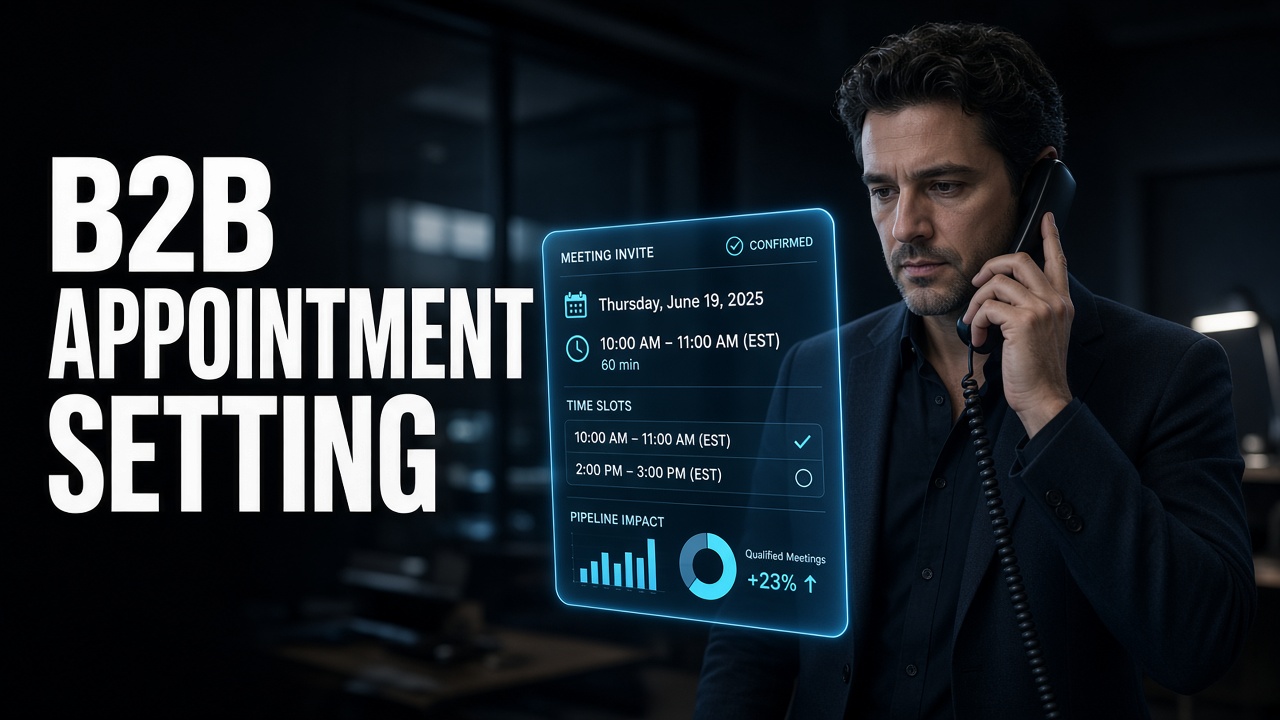
In brief: B2B appointment setting is not selling the product on the first call. It is earning a qualified meeting with the right decision-maker — without pressure, without a pitch dump, and without sounding like a script. Teams that book more meetings treat the call as a short business conversation: a clean open, good questions, and a next step the buyer actually wants.
In this article
- What “salesy” really sounds like — and why it kills the meeting
- Appointment setting vs selling on the first call
- The first 12 seconds
- The questions that book meetings
- Closing for a time slot without pushing
- FAQ

What “salesy” really sounds like — and why it kills the meeting
Most buyers do not hang up because you called. They hang up because the first 20 seconds sound like a pitch they did not ask for.
“Salesy” often sounds like this:
- A long intro about your company before you know who they are
- Features stacked before a single question
- Fake familiarity (“just circling back,” “a quick question”) when there is no relationship
- Pressure on the calendar (“I have a slot tomorrow at 10”) before they have a reason to care
- A script read so tightly it no longer sounds like a person
In B2B, the person who picks up is rarely the only one who decides. If the call feels like a trap, they will not book — and they will not introduce you inside the company either.
The opposite of “salesy” is not “soft.” It is specific. You know why you are calling this company, you respect their time, and you ask for a conversation — not a close.
Appointment setting vs selling on the first call
These are two different jobs. Mixing them is how good lists become burned lists.
Selling on the first call means trying to explain the offer, handle every objection, and push toward a decision before anyone has context. It is long. It is heavy. It sounds like a demo the buyer did not schedule.
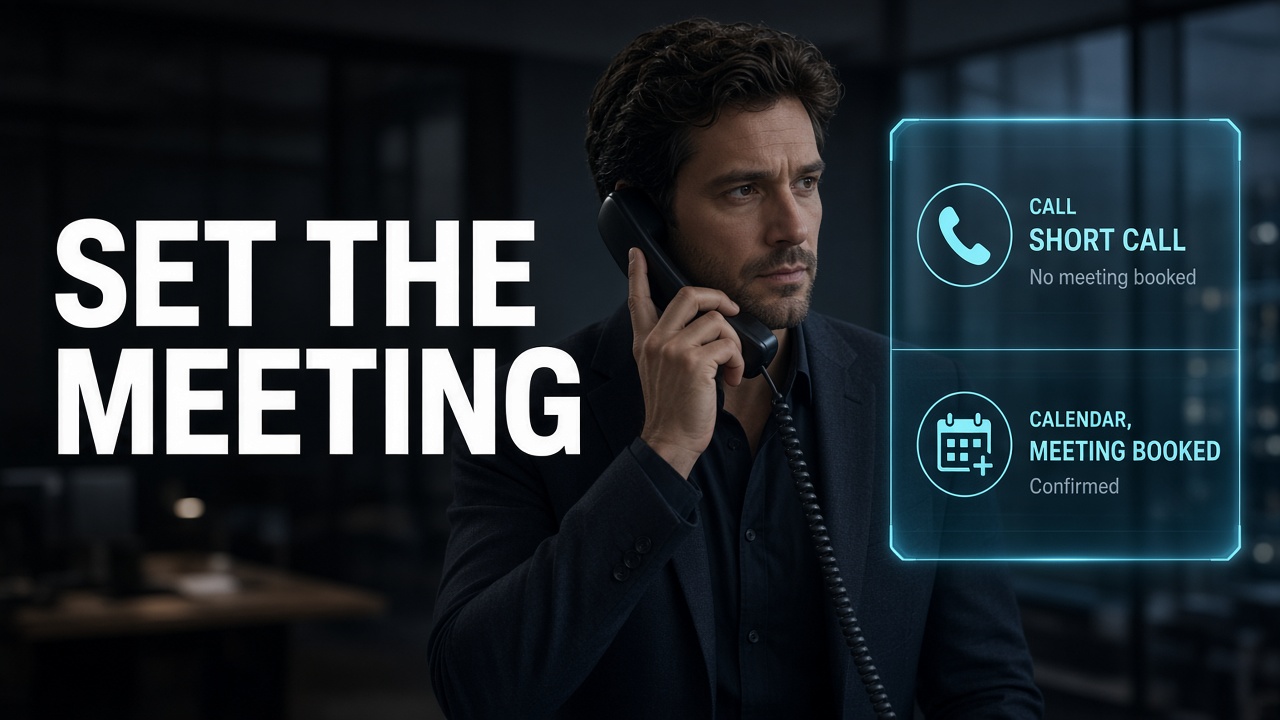
Appointment setting has a narrower finish line: a qualified meeting with someone who can actually move the file forward. The call is short on purpose. You confirm fit, you name the problem in their language, and you book time for a real conversation — with the right people in the room.
That is why appointment setting works so well for Canadian SMEs — especially teams selling across provinces, or from Quebec into English Canada. The first call opens the table. It does not fill it. The offer lives in the second exchange.
If your callers are still “pitching to get the meeting,” they are doing two jobs at once. Split them. Let the phone earn the calendar. Let the meeting do the selling.
Want meetings that actually move your sales forward?
The best place to start is a pilot project: we test your market at small scale before you accelerate.
Launch a pilot project · See B2B telephone prospecting · 514 990-9670

The first 12 seconds
You do not get a monologue. You get a greeting and a reason.
A clean open usually has four beats:
- Who you are — name and company, said once
- Why this company — one specific reason, not “I help companies grow”
- What you are not doing — you are not pitching the whole offer on this call
- Permission — “Have you got 30 seconds?” is better than talking over their no
Example shape (not a script to recite):
“It’s [first name] at Direct B2B. We help [type of company] get first conversations with [their buyers] in [English Canada / their market] — I’m not selling you a package on this call. Have you got half a minute?”
If they say no, you leave a clean out. If they say yes, you ask questions — you do not launch the deck.
Two rules protect the tone:
- One sentence about you. Then a question about them.
- Never read a paragraph. If it sounds written, it sounds fake. That is the same idea as “a perfect script sounds false in two sentences.”
AI can draft openings. A human still has to say them like a person — and skip anyone who already said they were not interested.
Key takeaway.
The first 12 seconds open the door or close it. Name + specific reason + permission — then you listen.

The questions that book meetings
The meeting is booked in the questions, not in the pitch.
Good appointment-setting questions do three things: they show you did a minimum of homework, they let the buyer talk, and they reveal whether a meeting is even useful.
Questions that often help:
- “Who owns first conversations with new accounts right now — you, or someone on the team?”
- “When a decision-maker goes quiet on email, what happens next on your side?”
- “If you opened [Ontario / the West / a new vertical] this quarter, who else would have to say yes after that first meeting?”
- “Is the gap more about getting the first call — or about what happens on the second?”
Questions that often hurt:
- Anything you could have Googled
- A list of five qualification questions fired like a form
- “What keeps you up at night?”
- Closing for a meeting before they have said anything real
Listen for the soft yes: they name a problem, a market, or a person. That is your signal to offer time. If they are polite but empty, do not force a slot. A meeting nobody wants is worse than no meeting.

Closing for a time slot without pushing
Closing for a meeting is just naming a next step that already makes sense.
A clean close:
- Replay their words — one sentence, not a summary of your offer
- Name the meeting — 20–30 minutes, with whom, about what
- Offer two time slots — not “when are you free?”
- Confirm the invite — email, and who else to copy
- Stop talking
Example:
“If the issue is getting a real first conversation in English Canada, that’s exactly what we’d unpack — 25 minutes with you and whoever owns that market. Tuesday 10:30 or Wednesday 2:00 — which is cleaner?”
If they hesitate, give them an out that keeps the door usable:
“If the timing isn’t right, I’ll leave it. No follow-up barrage — you can reply to the note if you want to come back to it later.”
That last line is not weakness. It is how you stay welcome on the next list.
Five rules if you want more meetings without sounding “salesy”:
- Set meetings. Do not sell the product on the first call.
- Open in 12 seconds. Then ask.
- Use their market language, not your slide titles.
- Book only when there is a real reason.
- Approve the talk track. Then let humans sound human.
Key takeaway.
A clean close replays their words, names 20–30 minutes, offers two slots — then goes quiet.
FAQ
What is B2B appointment setting?
It is outbound work whose goal is a qualified meeting with a decision-maker — not a product close on the first call. The phone earns the calendar; the meeting does the selling.
How do you book more meetings without being pushy?
Be specific about why you called, ask questions before you pitch, and close for a short, named next step. Pressure on the calendar before there is a reason is what sounds “salesy.”
How long should an appointment-setting call be?
Short. If you are still explaining the offer after a few minutes, you are selling — you are not setting. Confirm fit, book the meeting, get off the line cleanly.
Does this work in English Canada and Quebec?
Yes — the structure is the same. The language and the “why this company” line change. Bilingual teams can run both without forcing one script across markets.
Can AI write the talk track?
It can draft openings, questions, and follow-ups. A person still has to approve and deliver them. Buyers can hear a script. They can also hear a conversation. (See also: How AI Helps B2B Sales Prospecting Teams.)
To go further on what a real qualified meeting is — and how many to expect — read The qualified B2B meeting. For broader SME context on marketing and sales, BDC publishes useful resources.
About the author
Direct B2B Telemarketing. Since 2005, Direct B2B has supported Canadian SMEs with B2B telephone prospecting: decision-maker qualification, a talk track you approve, and appointment setting that is AI-powered + human-accomplished — without pressure selling.
Ready to test it?
Interested in a pilot project
Book an exploratory conversation — we will walk through your markets, who should be on the first call, and how appointment setting should sound for your brand.
Book a call · Schedule an exploratory meeting
Or call 514 990-9670 · directb2b.ca
Direct B2B — AI-powered + human-accomplished. B2B appointment setting across Canada.